
Flexible batteries for wearables
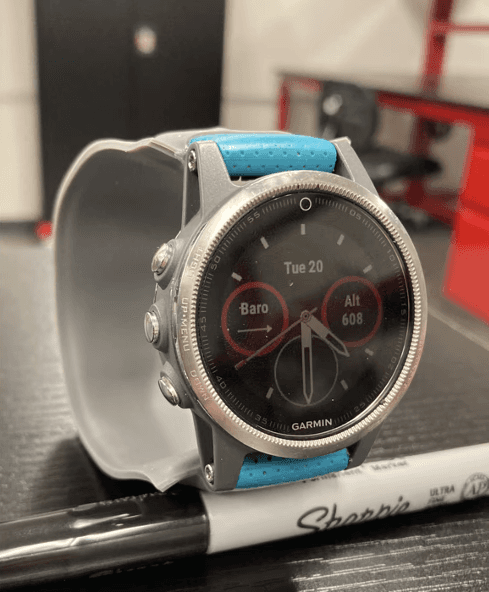
Final prototype of flexible battery connected to base of Garmin Fenix 5 watch.
Project Type
Ideation and prototyping:
Tools
Wet laboratory work, battery assembly, silicone curing, soldering, battery cycling, Arduino
Team
Solo, in <10 person startup
Contribution
Ideation and prototyping:
Material and device selection
fabrication
device integration
Outcome
Functional proof-of-concept of flexible battery powering a smartwatch
Duration
2 months sprint, Jan-Mar 2021
Context
As an early engineer at battery materials startup Anthro, I prototype flexible batteries integrated into a wearable smartwatch.
At the time of this project, Anthro was exploring how its proprietary electrolyte material could be used in flexible form factors for wearable electronics. What if batteries could conform to their device's shape, and not the other way around?
Previous work on creatively using stretchable, flexible batteries
Based on research our team conducted at Stanford on stretchable batteries, we knew how to make experimental batteries that could bend, twist, and distort while continuously powering a device.
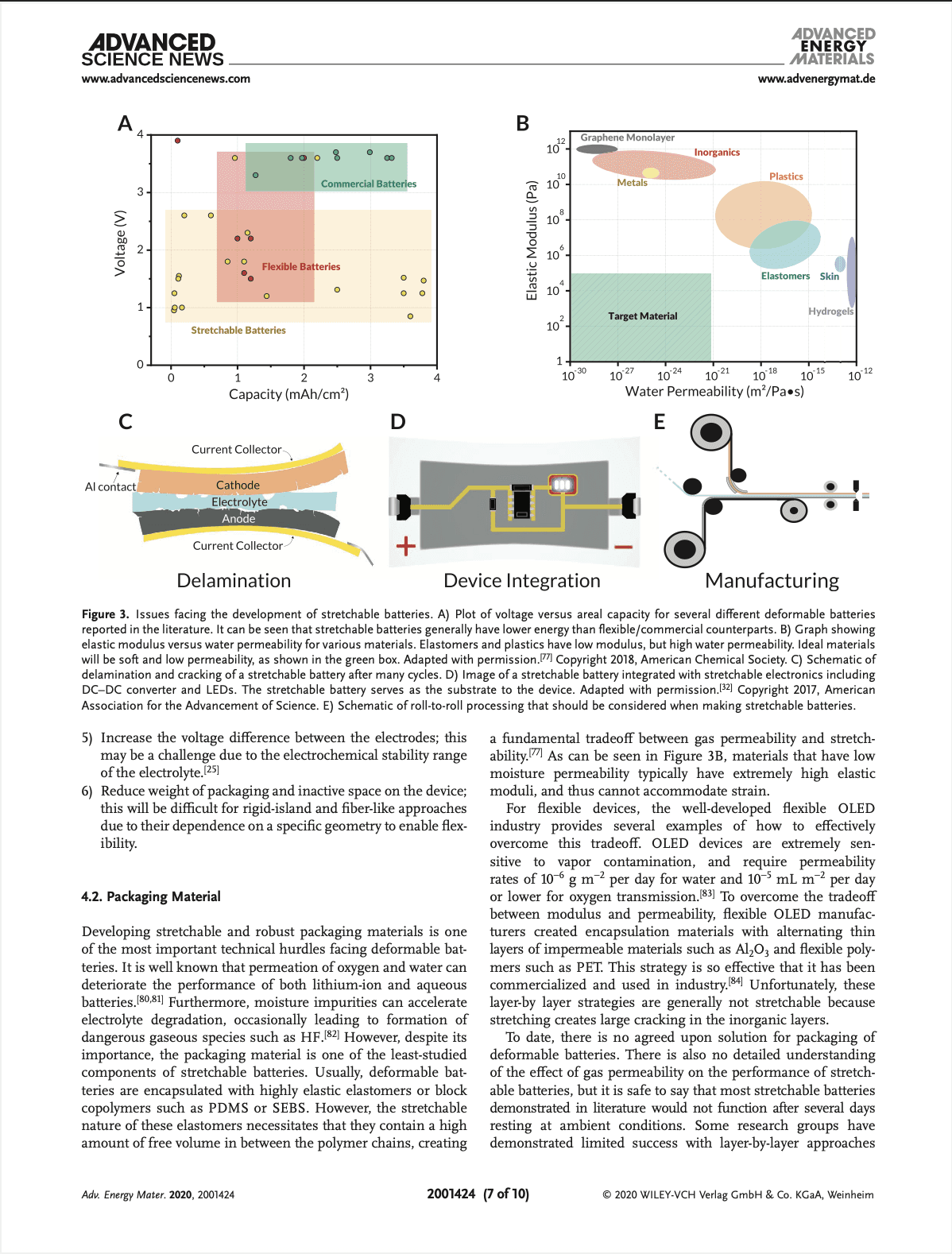
Excerpt from a paper I helped publish with my graduate supervisor on stretchable battery's design applications.
Pre-sprint Work
Interviews: Why flexibility?
Previous to this design sprint, our team had conversed with ~50 interviewees about what design problems device engineers, materials scientists, and management faced in the wearables space, particularly around the battery.
All conversations pointed to key issues:
Wearable devices are severely power-limited. A big problem for end users is the frustration of constantly charging devices with short battery life.
Battery life issues
are exacerbated as wearable device functionalities become more powerful and there is a greater need for more power
Devices are constrained to the size and shape of the battery. This limits the form factor that devices can take up, and the size of the battery that can be used.
“We are very power-limited on wearables."
“I would love to put a battery in the wristband of the device if I could find a battery to do that."
“The key limitation of our industrial design is the battery."
Aware of our work around with batteries, many interviewees expressed keen interest in using our flexible batteries to solve battery issues found in wearables. With flexible batteries, substantially space could be made for other electronic components to enhance the device's functionality. This was the goal of our proof-of-concept.
Ideation
Where do you put a flexible battery?
Given our user conversations, we decided how to focus on integrating flexible batteries into the “dead space" of wearable devices: within the fabric of smartpatches, inside the wristband of smartwatches, or in the frames of glasses.
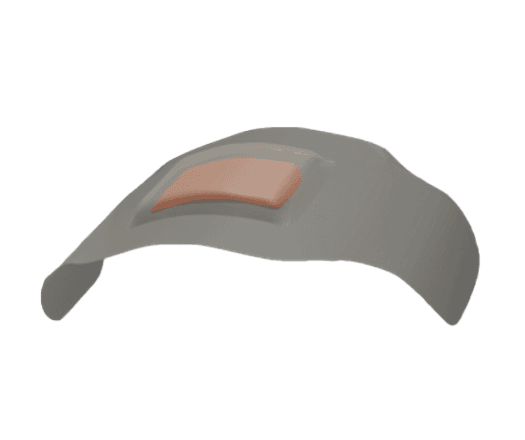
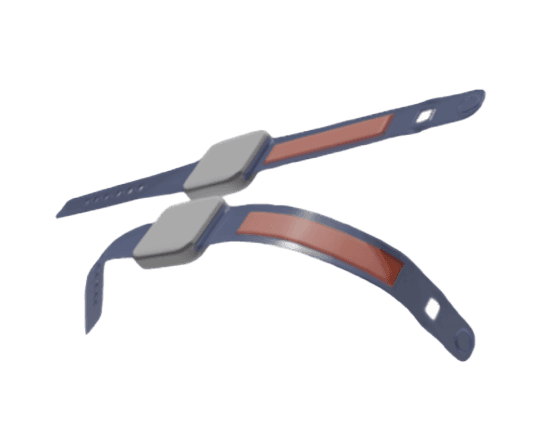
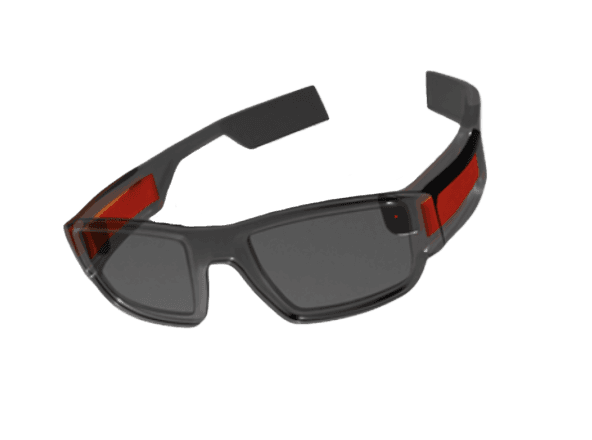
Some renderings of potential battery location (orange) in smart patches, smartwatches, or smart glasses.
How do you make a flexible battery?
Like this:
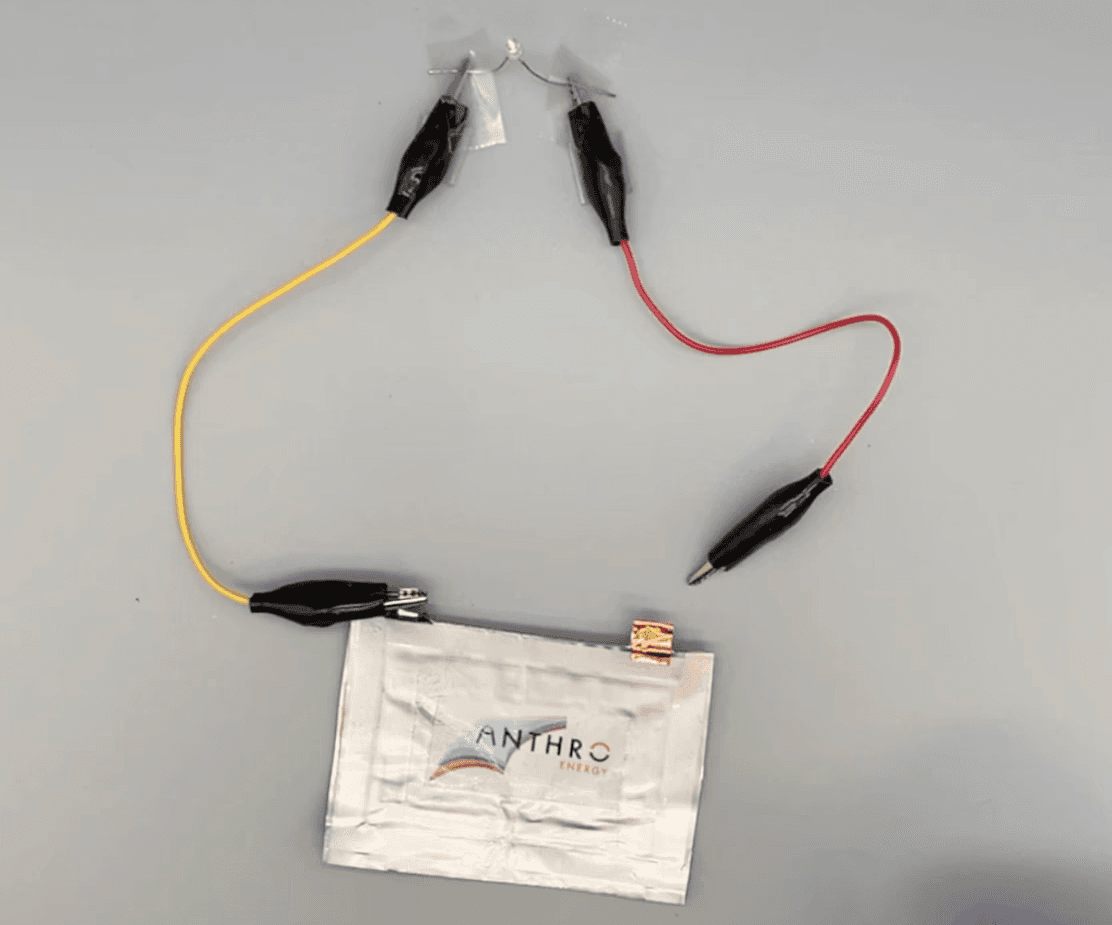
Early pouch cell powering an LED. Picture from pre-Anthro at Stanford lab.
We had previously fabricated flexible batteries in the laboratory. Each battery consists of a flexible electrolyte core, conductive cathode and anodes, and a bendable metallic casing that completes this “pouch cell." When ideating the battery, we brainstormed different dimensions, ratios, and types of internal components to use.
Below is a rough diagram showing how different layers of the battery were prepared by machine, assembled by hand, and vacuum sealed into the final product.
Prototyping
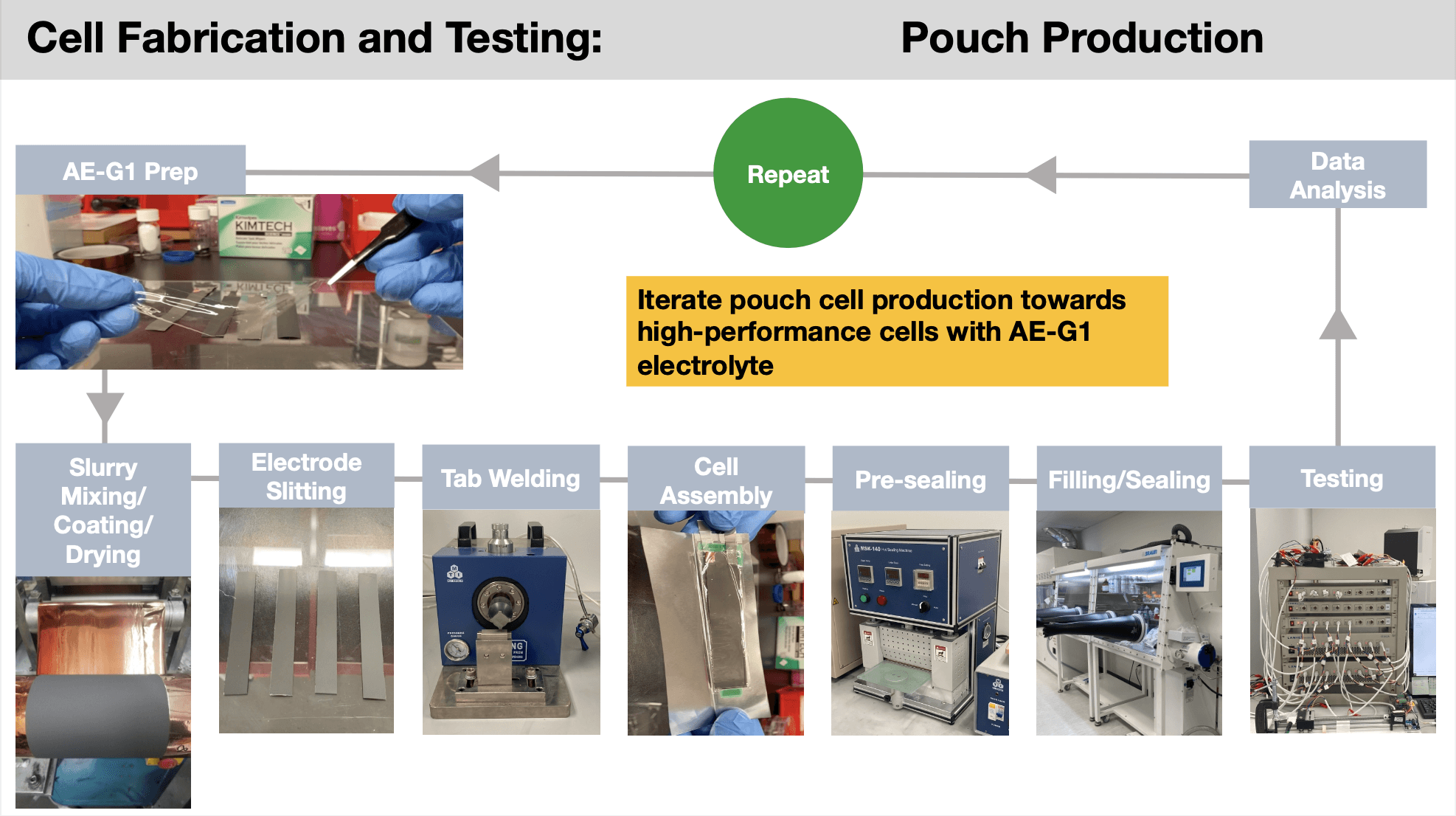
A rough diagram showing cell fabrication process, from preparing electrolyte to coating electrodes, assembling layers, sealing pouch, and testing on a battery cycler.
Device Selection
We determined smartwatches to be the best type of device to use in this demo. Integrating our battery with a smartwatch would clearly demonstrate our battery's function without a huge current draw. The idea was to replace the smartwatch's wristband with a custom silicone prototype embedded with a battery inside.
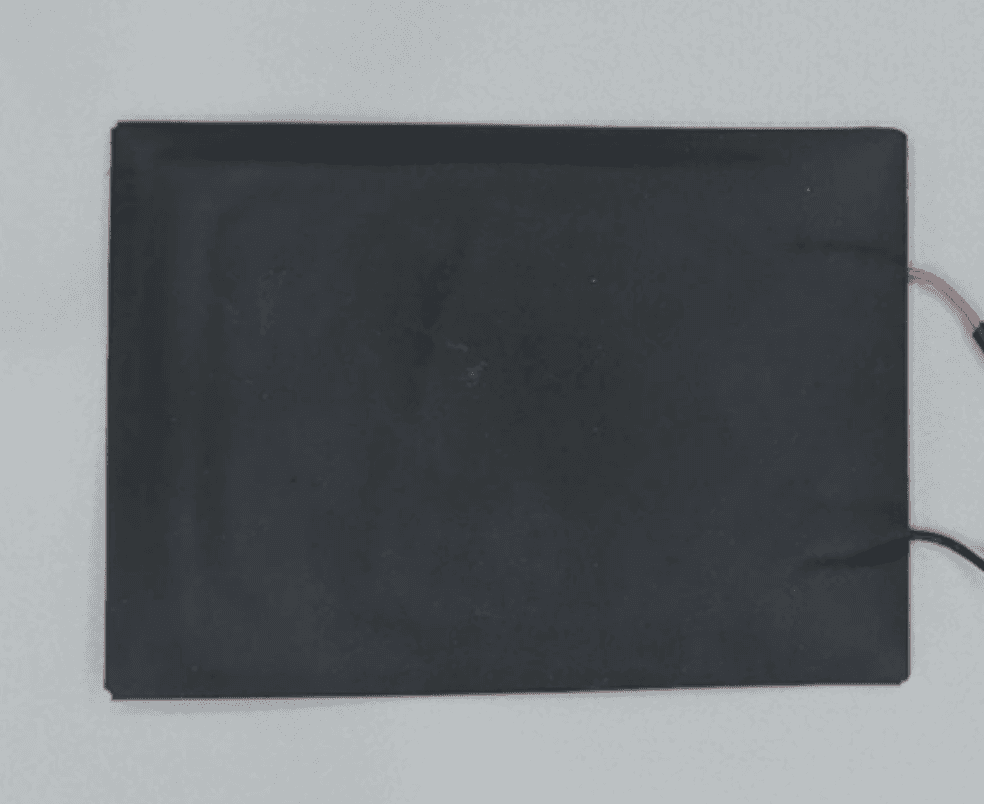
One of several cell form factors fabricated during ideation, sealed within silicone and with wires welded to the battery tabs.
Smartwatch Teardown
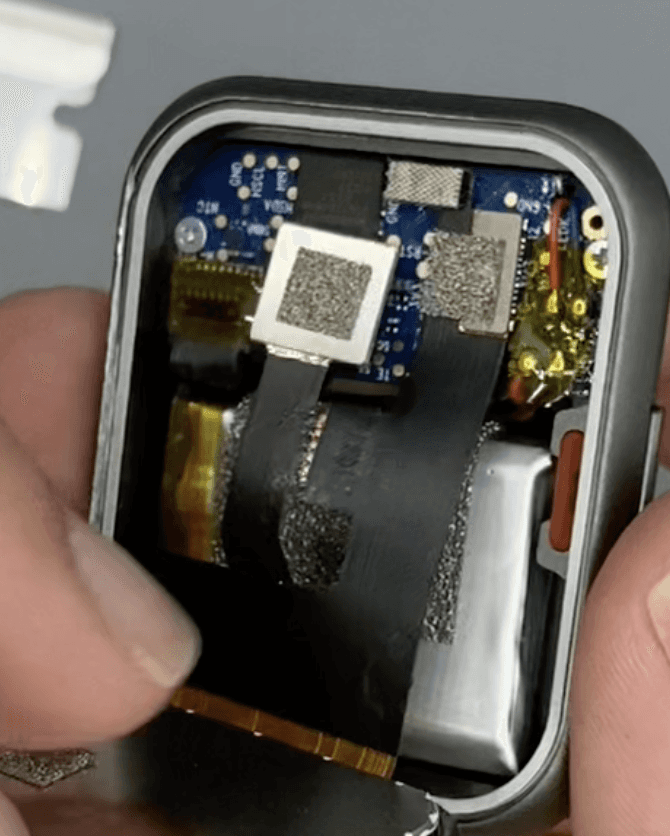
Smartwatch teardown showing battery and other internal components.
Teardown was an essential part of this prototyping process, in order to access and remove the internal battery.
We removed the adhesive seal holding the watch display onto its base, before also removing the battery and its built-in safety circuit.
Encapsulating Custom Batteries
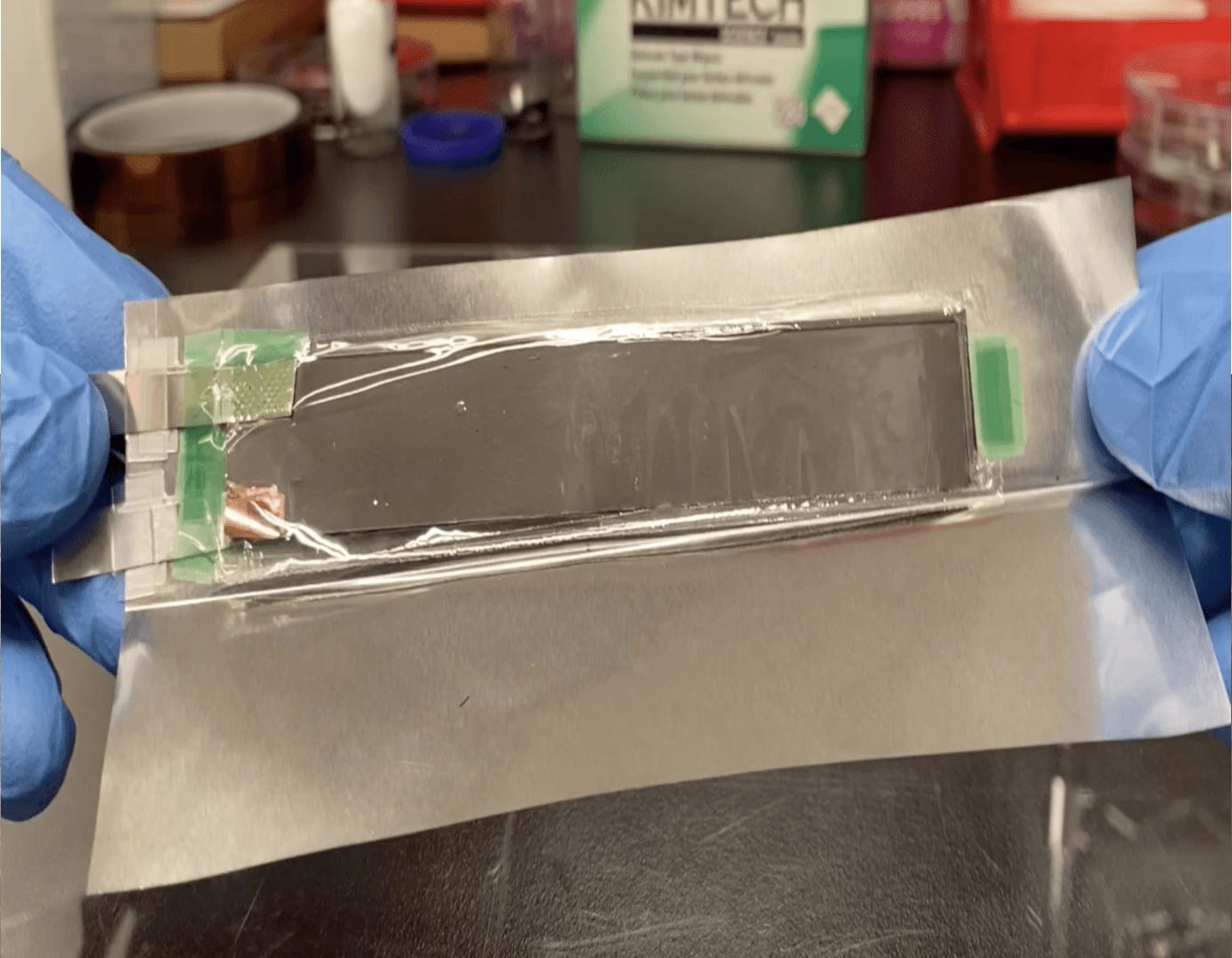
Long form factor of cell during fabrication, before sealing.
Having selected the device to integrate our battery with, we could use the OEM dimensions of the smartwatch to design a wrist-band shaped battery. We based the capacity on the rough current draw of the smartwatch to be integrated with, which corresponded with battery thickness.
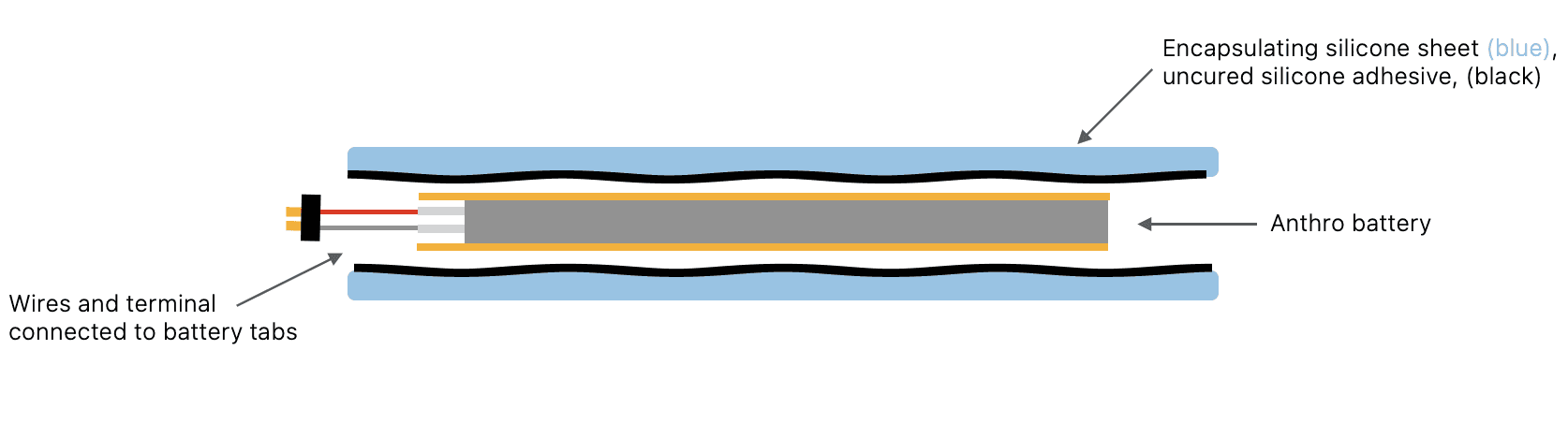
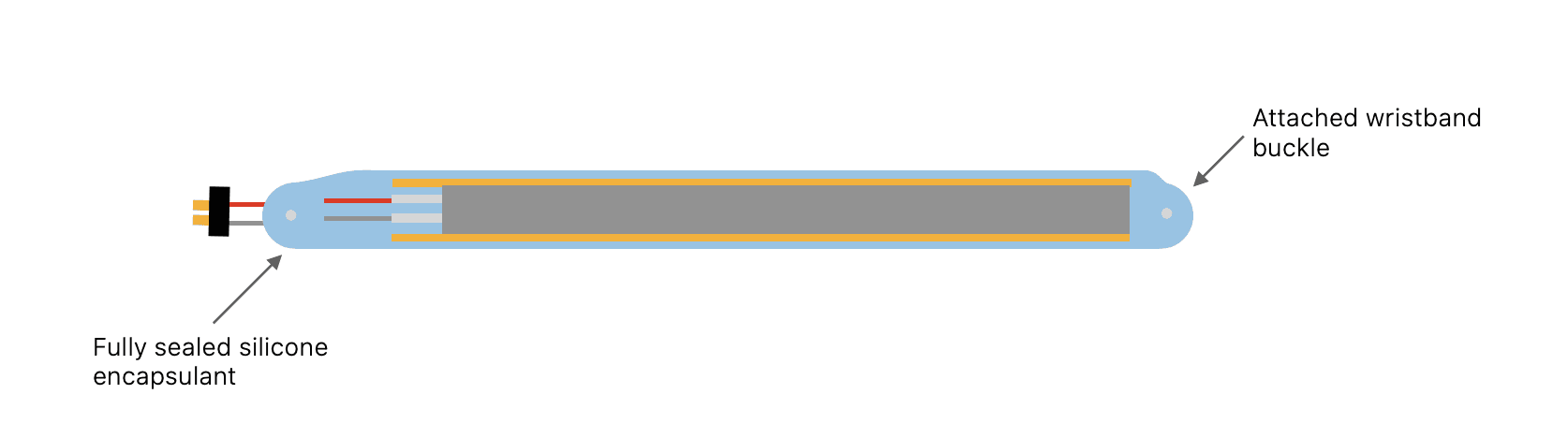
Rough diagram showing how silicone encapsulation is done. This process forms the watch strap for the watch, with the battery inside.
After fabrication, the battery was encapsulated in a makeshift “wristband” made out of self-fabricated silicone. Wires were first soldered onto the metal tabs to ensure that the battery terminals could still connect to a device after encapsulation.
Next, silicone rubber sheets were prepared by polymer curing and coating. These sheets were cut to size so that the battery was perfectly sandwiched by two sheets. The sheets were cured together to seal the battery inside and complete the encapsulation. Lastly, we attached a wristband buckle to one end of the battery, enabling it to function as an attachable wristband.
Integrating with Smartwatch
With the original battery was removed, we could solder our in-house battery to the watch's safety circuit. Our batteries had wires welded to their tabs, so we soldered the other ends of the wires to the internal circuit.
We resealed the device screen with our own adhesive seal and attached the “wristband” to the smartwatch base.
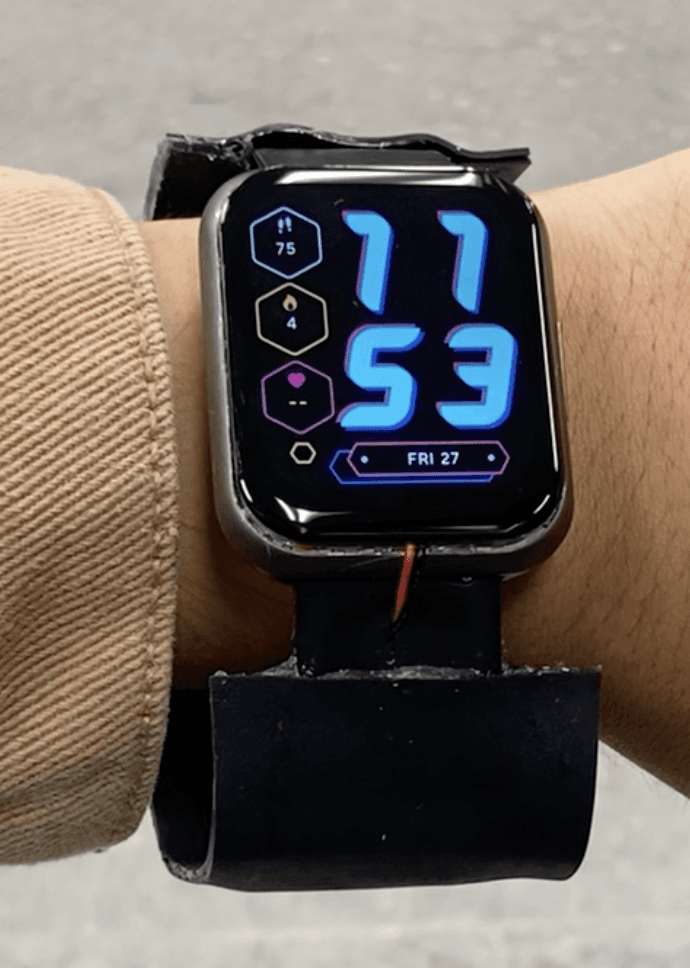
Early iteration of a flexible battery-integrated smartwatch.
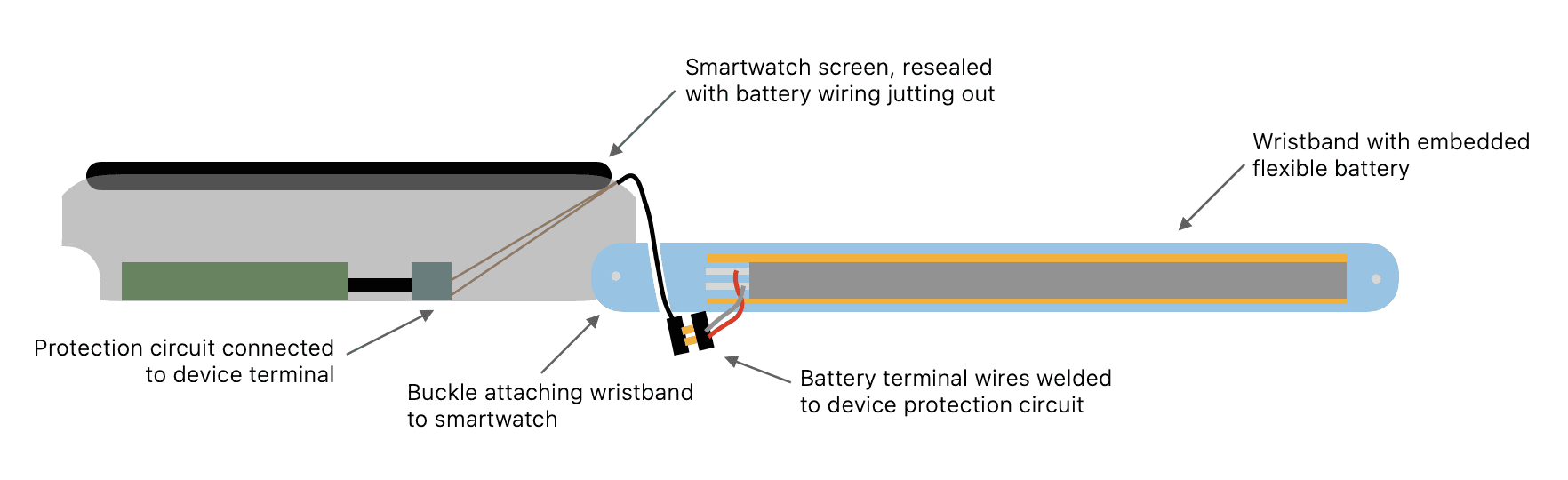
Rough diagram of how integration was performed. Note the JST terminals joining watch and battery tabs.
Flex testing with watch in idle mode while silicone-encapsulated battery is flexed on a linear actuator. We programmed several actuators with an Arduino Uno, with testing done at varying speeds and cycles while we monitored battery health an mechanical properties.
Once successfully integrated, we could operate the smartwatch normally. I worked with engineers to monitor battery output during use, such as performing bend testing with an Arduino-controlled linear actuator during idle mode.
Final Deliverable
Variations with Different Smartwatches
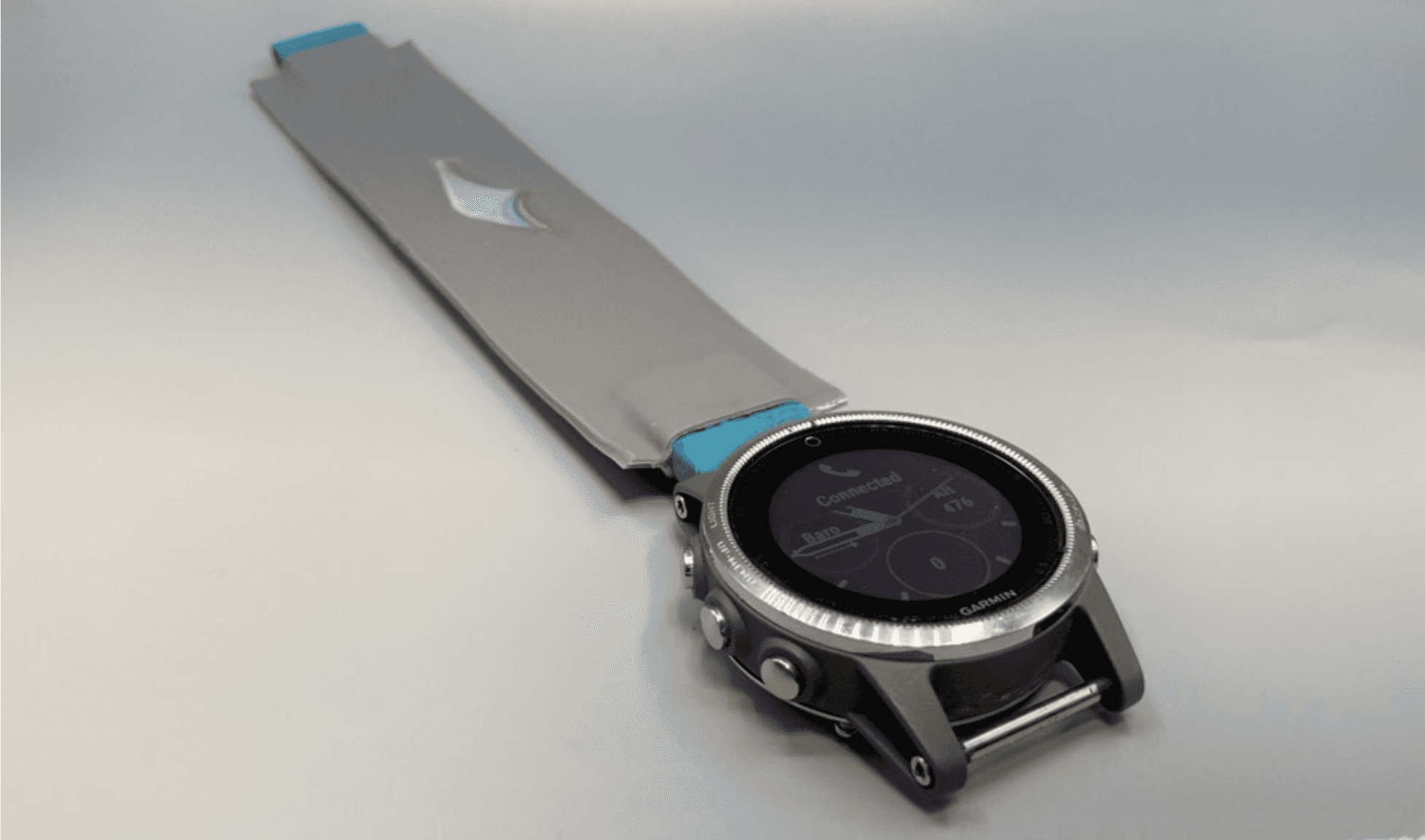
Flexible-battery integrated smartwatch, Garmin Fenix 5.
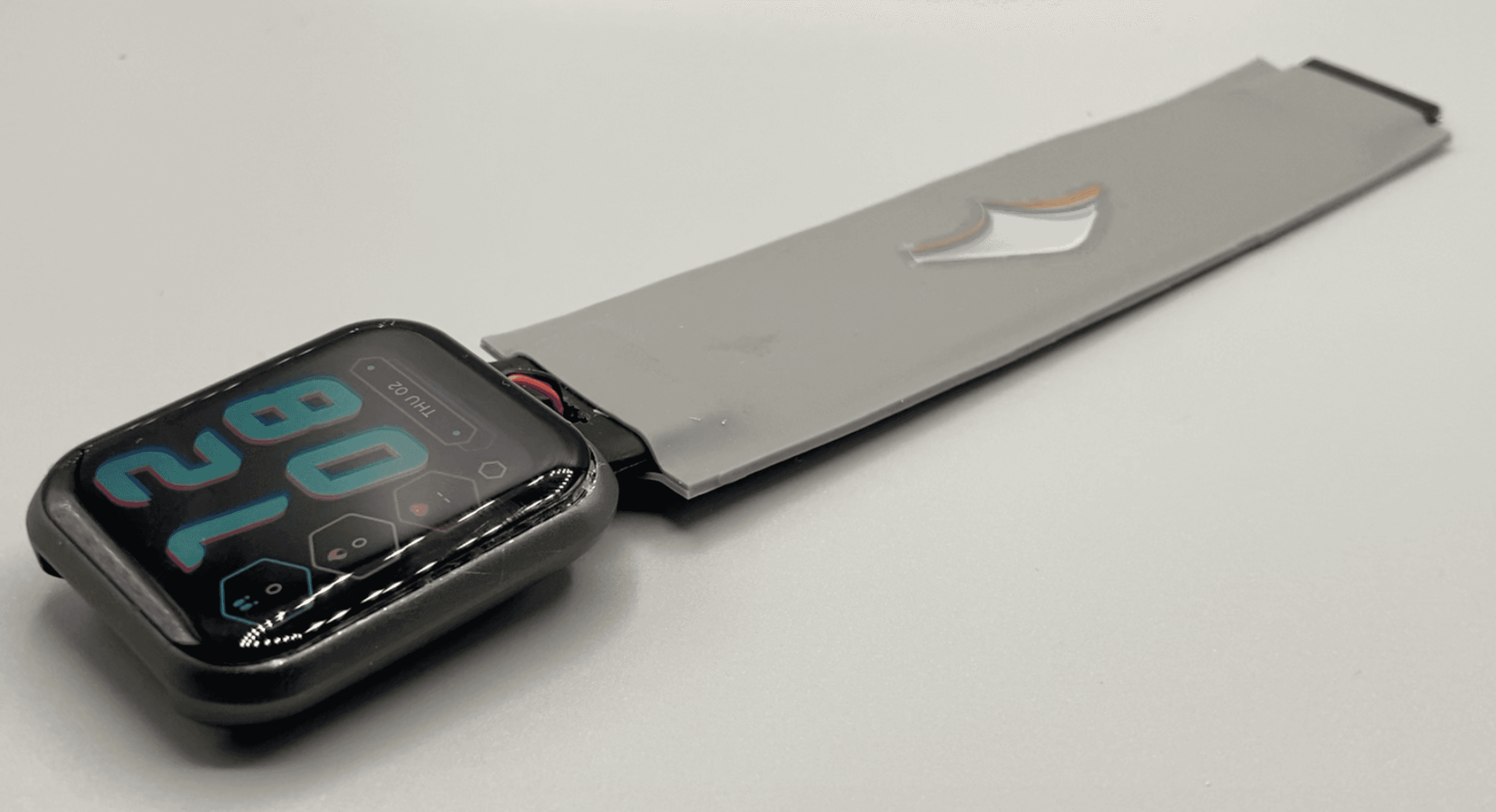
Flexible-battery integrated smartwatch, Wyze watch.
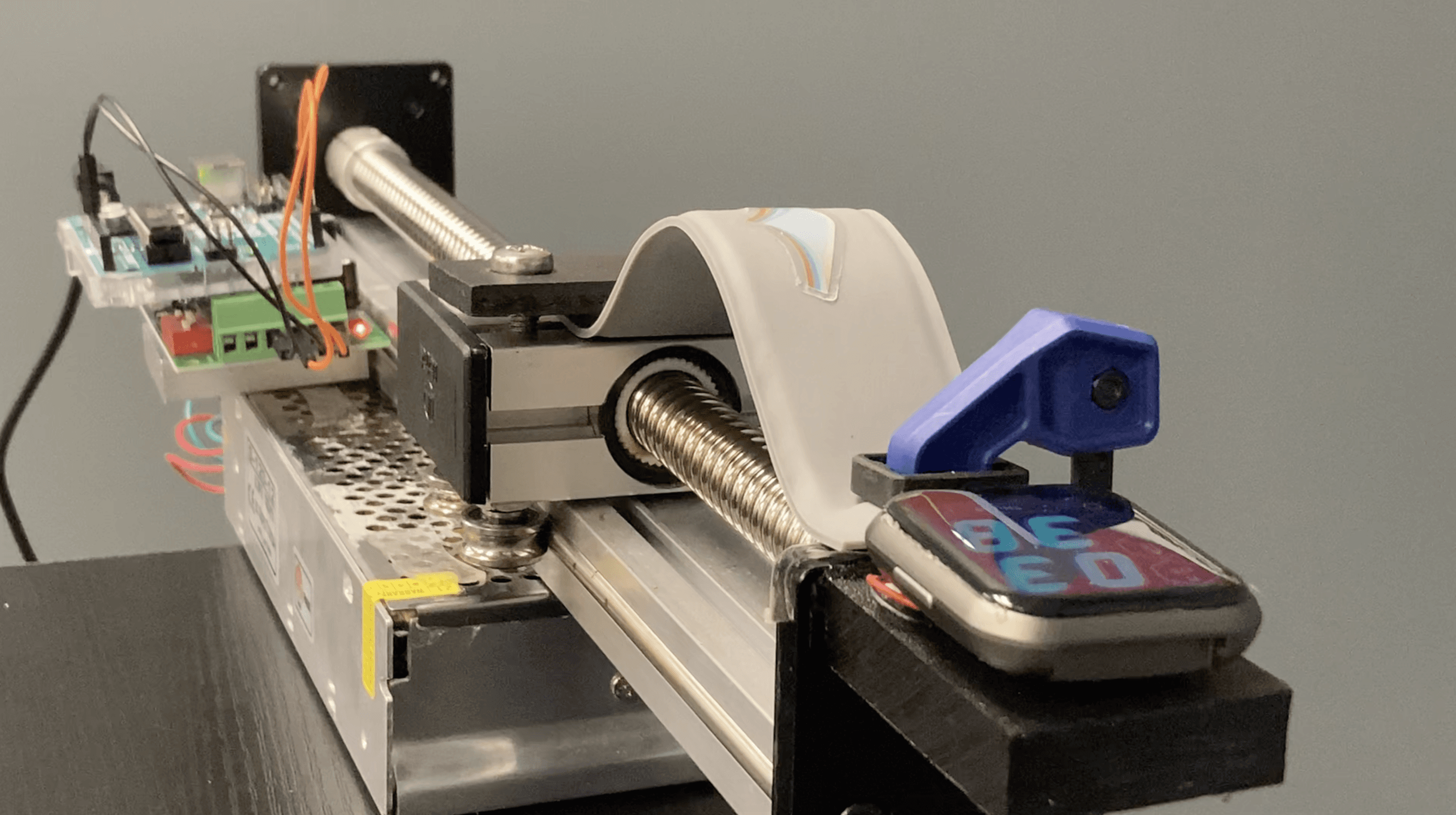
Flexible-battery integrated smartwatch, during flex testing.
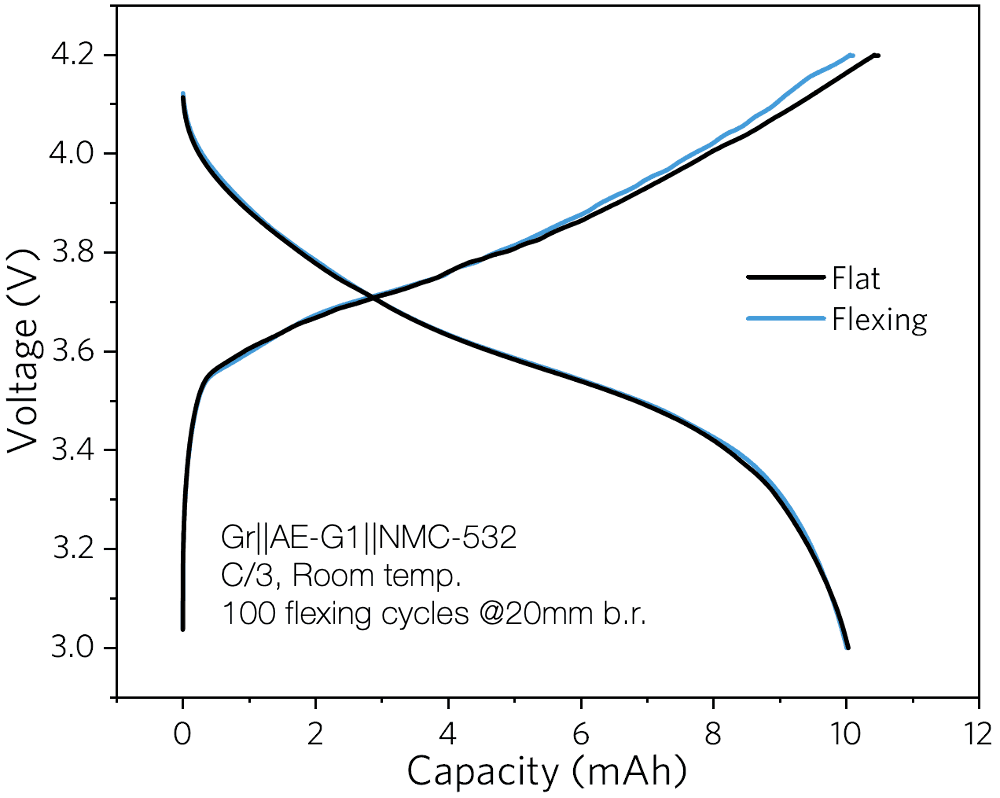
Early voltage-capacity plot showing performance during flexing compared to no flexing, after 100 charge-discharge cycles with 20mm bending radius.