
Cuberg: Battery mechanical design for mobility
Project Type
Cell mechanical design, battery engineering, design for manufacturability (DFM)
Tools
CAD (Onshape), FMEA, physical assembly, tolerance analysis, statistical process control
Team
Cross-functional: R&D, engineering, process, manufacturing, strategy
Contribution
Constraints/failure analysis
Ideation
Prototyping
Handoff and process implementation
Outcome
Completed design specifications, handoff to manufacturing for production
Duration
6 months design cycle
Context
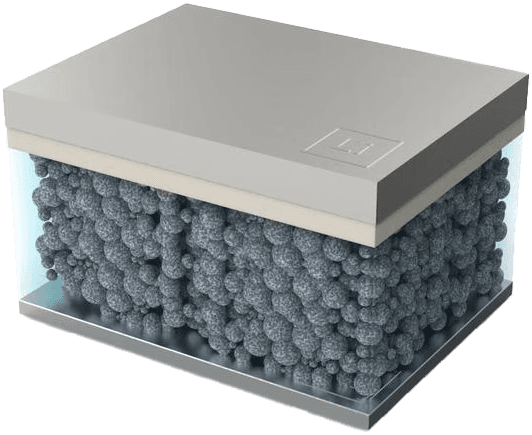
Rendering of Cuberg's advanced material stack comprising its Li-metal batteries (marketing material)
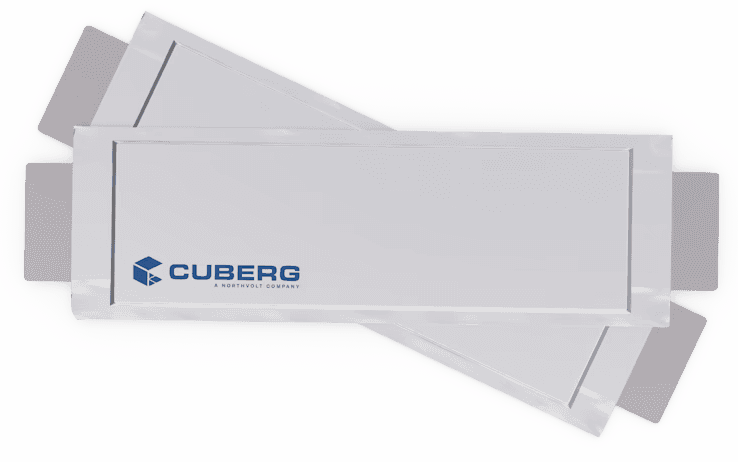
Cuberg was a battery materials company that built high-performance Li-metal batteries to electrify air and land mobility. A key priority in 2023 was scaling up production and standardizing battery design across customers. Our team focused on this new concept's mechanical design, specifically battery form factor, dimensions and tolerances.
We were given battery performance requirements from our external customers (mobility companies) with manufacturability requirements from our internal manufacturing team. Concerned with both engineering performance and design for manufacturability (DFM), we asked:
How might we design our battery's form to meet high performance standards while increasing our manufacturing speed?
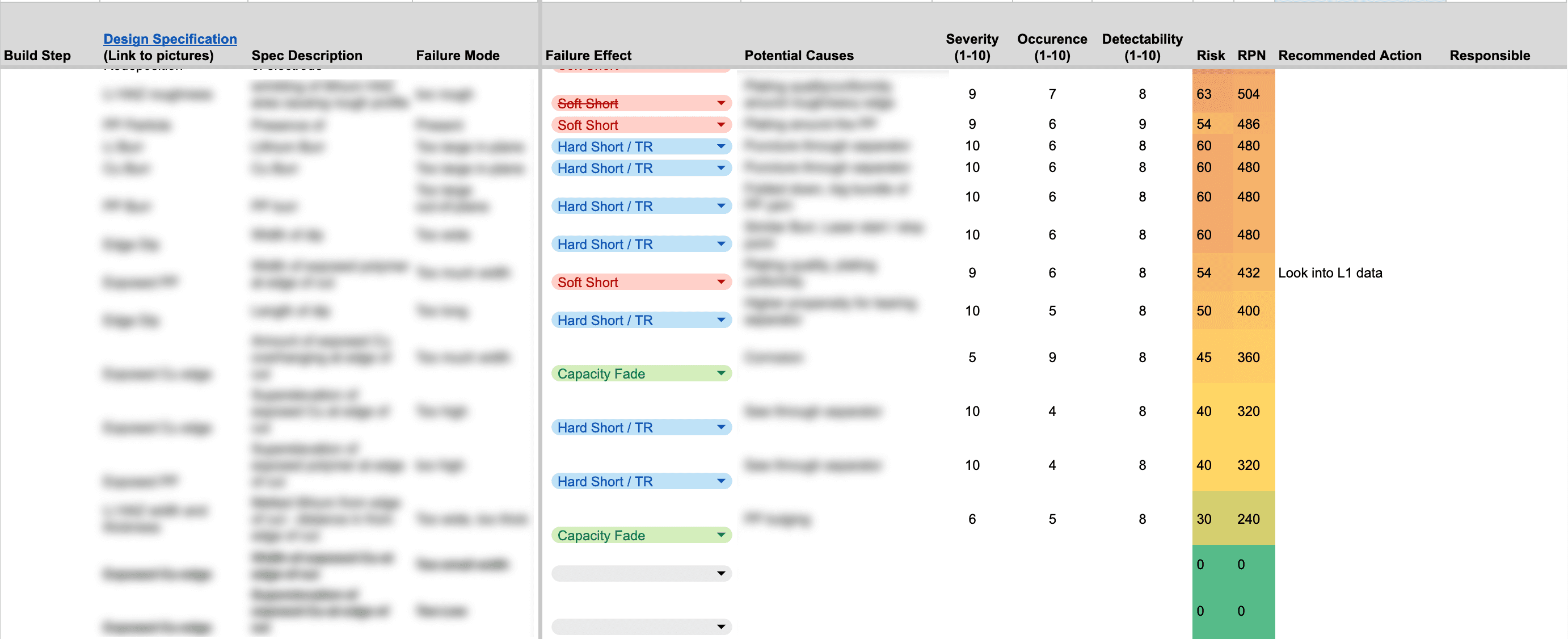
Excerpt of DFMEA document created at the start of the design process to identify design constraints (sections blurred for IP reasons).
Constraints
We began by establishing design constraints based on battery materials provided by our R&D team, and performance requirements based on product strategy.
Given constraints, we performed a design failure mode and effects analysis (DFMEA) to identify critical dimensions in our design process. Parameters assigned higher risk were given more attention to ensure precise implementation of design in production. This DFMEA review took place over several weeks with the contribution of stakeholders of R&D, engineering, process, and manufacturing teams.
Our analysis results prioritized design precision, given the high risks of flammable components misaligning and causing fire hazards. The key challenge for us going forward was achieving a mechanical design with precise tolerances without compromising manufacturing speed and project cost.
Ideation
Exploring Nominal Dimensions
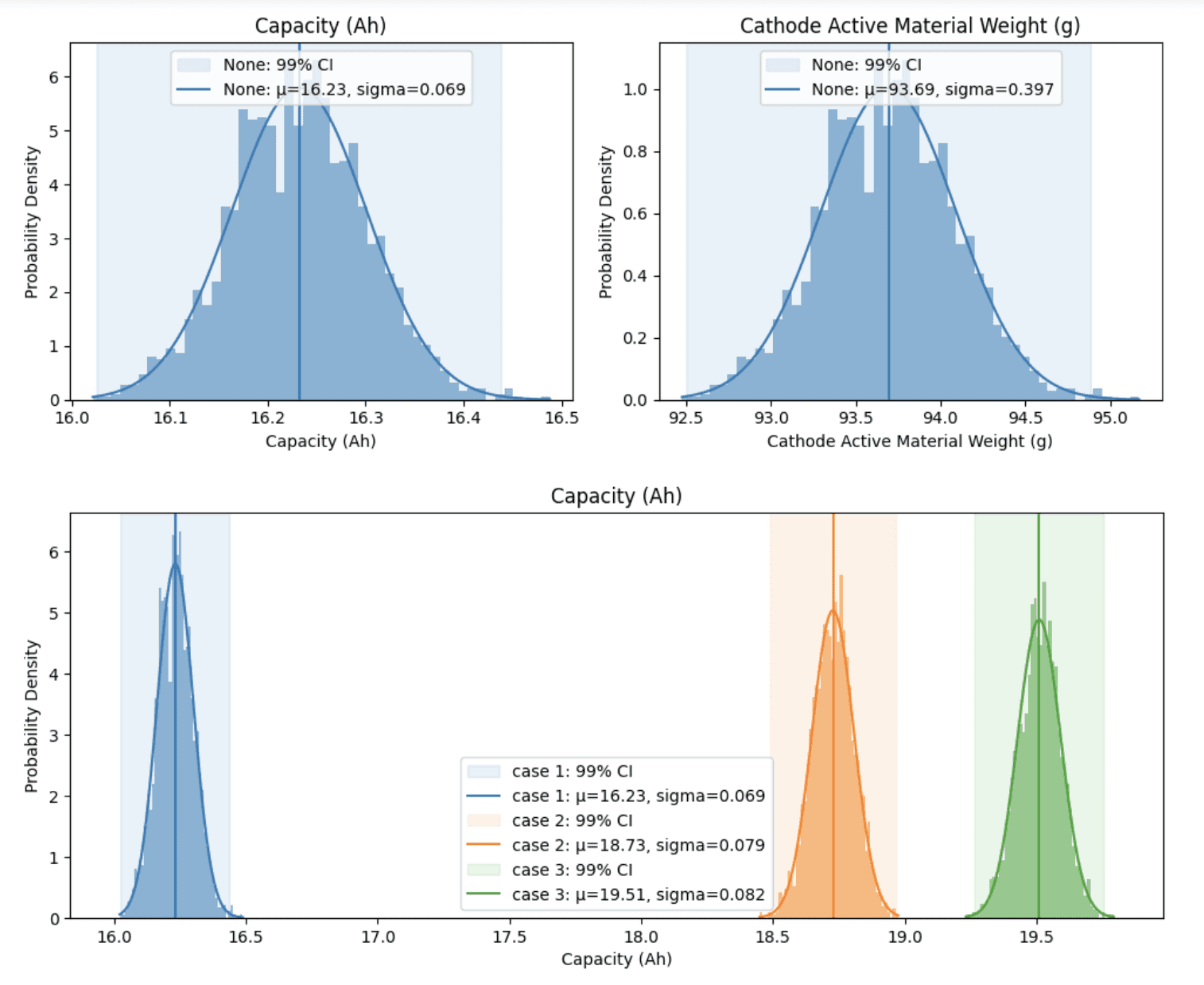
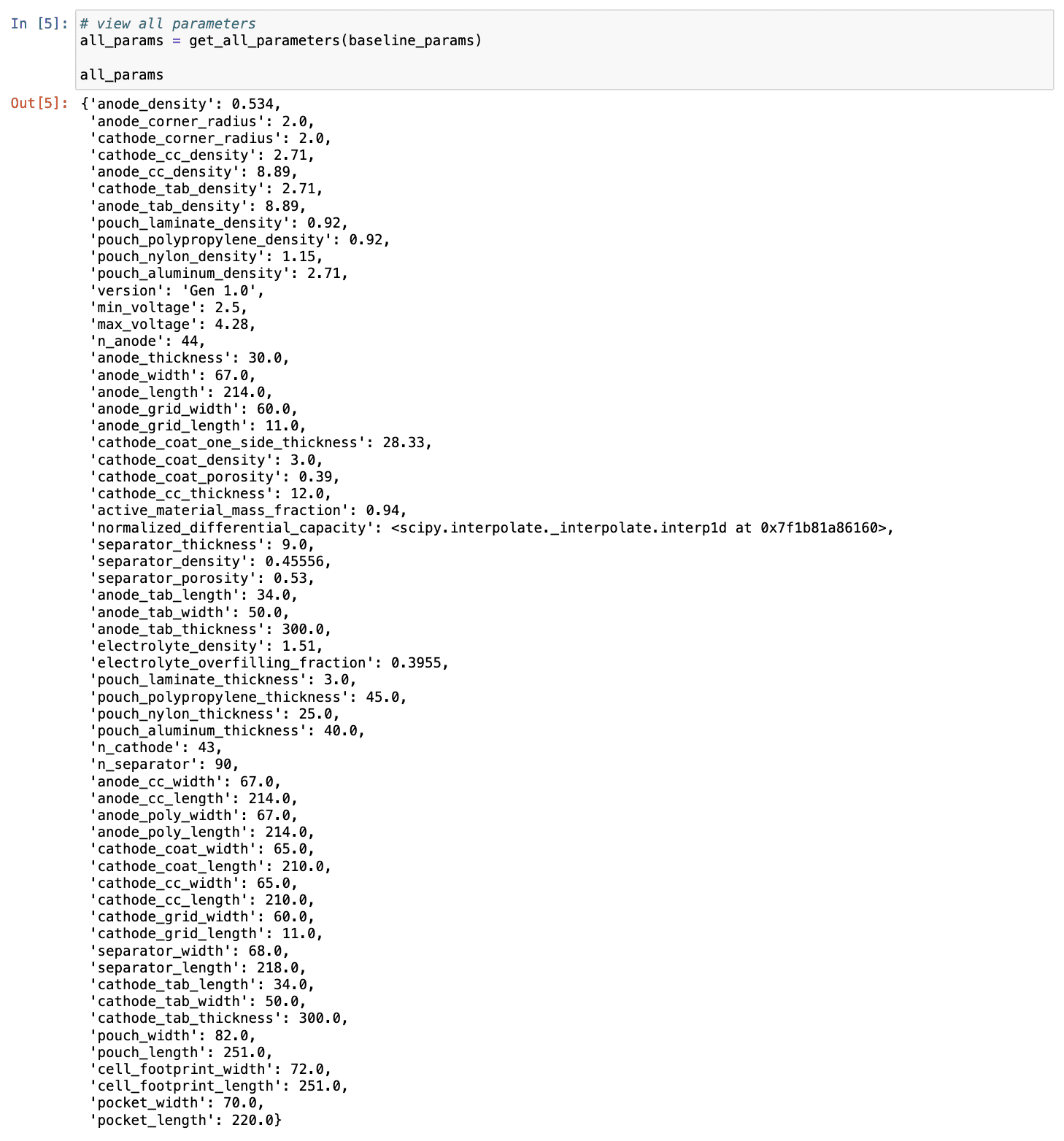
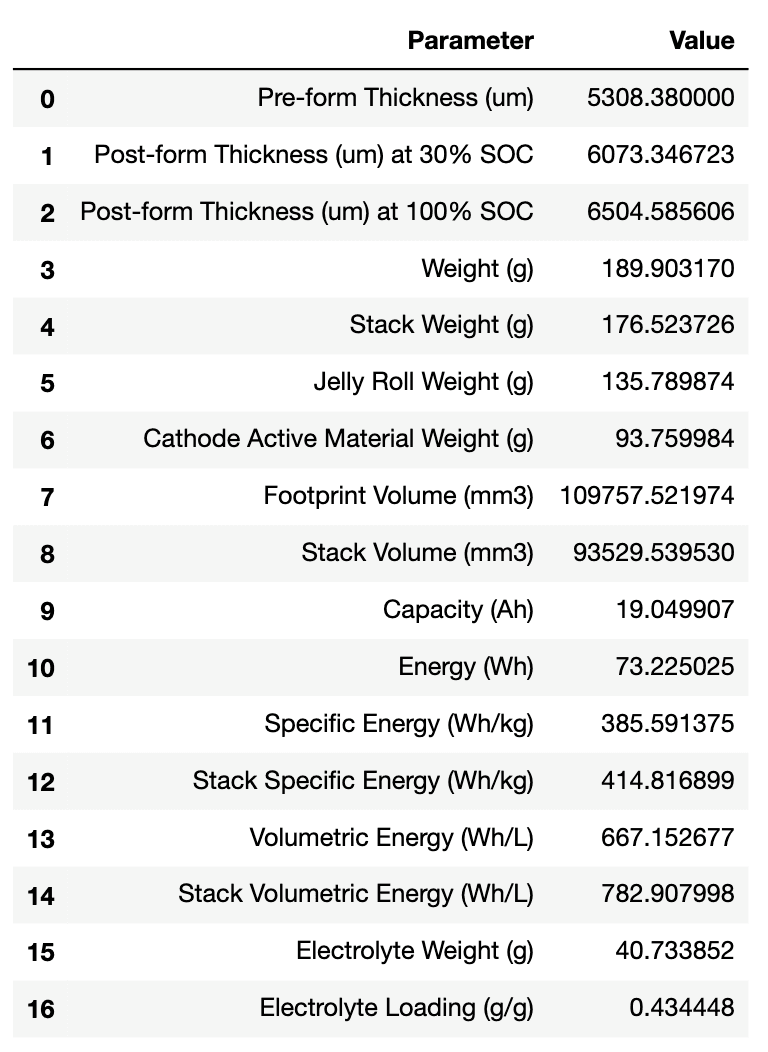
Python script containing input dimensions, output performance characteristics, and distribution curves of cell capacities as a function of inputs. Co-created with Cuberg's battery modeling team to facilitate easier ideation for mechanical work.
Working with R&D, battery modeling, and process engineering teams, we create a matrix of all measurable dimensions of our battery and explored variations of these dimensions in our design. We evaluated these variations based on (1) how they achieved optimal battery performance with minimal material use and (2) absolute limits based on manufacturing constraints. This exercise enabled us to determine rough nominal dimensions to start with.
CAD Mockups
Understanding constraints enabled us to roughly determine dimensions for all cell components. We also established what components we needed in the first place and a preliminary bill of materials. With preliminary dimensions and BOM, we could mock up CAD component models and drawings.
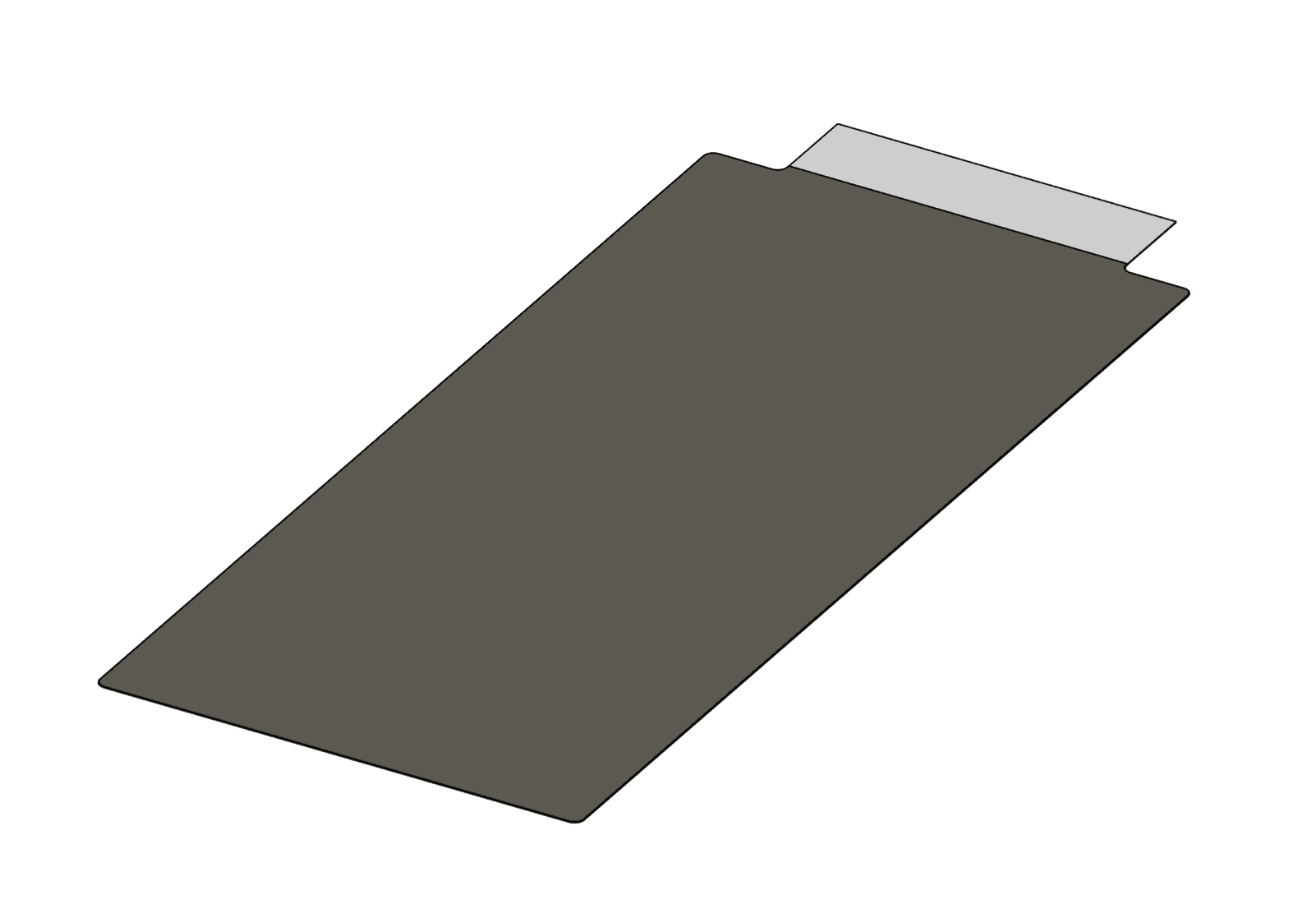
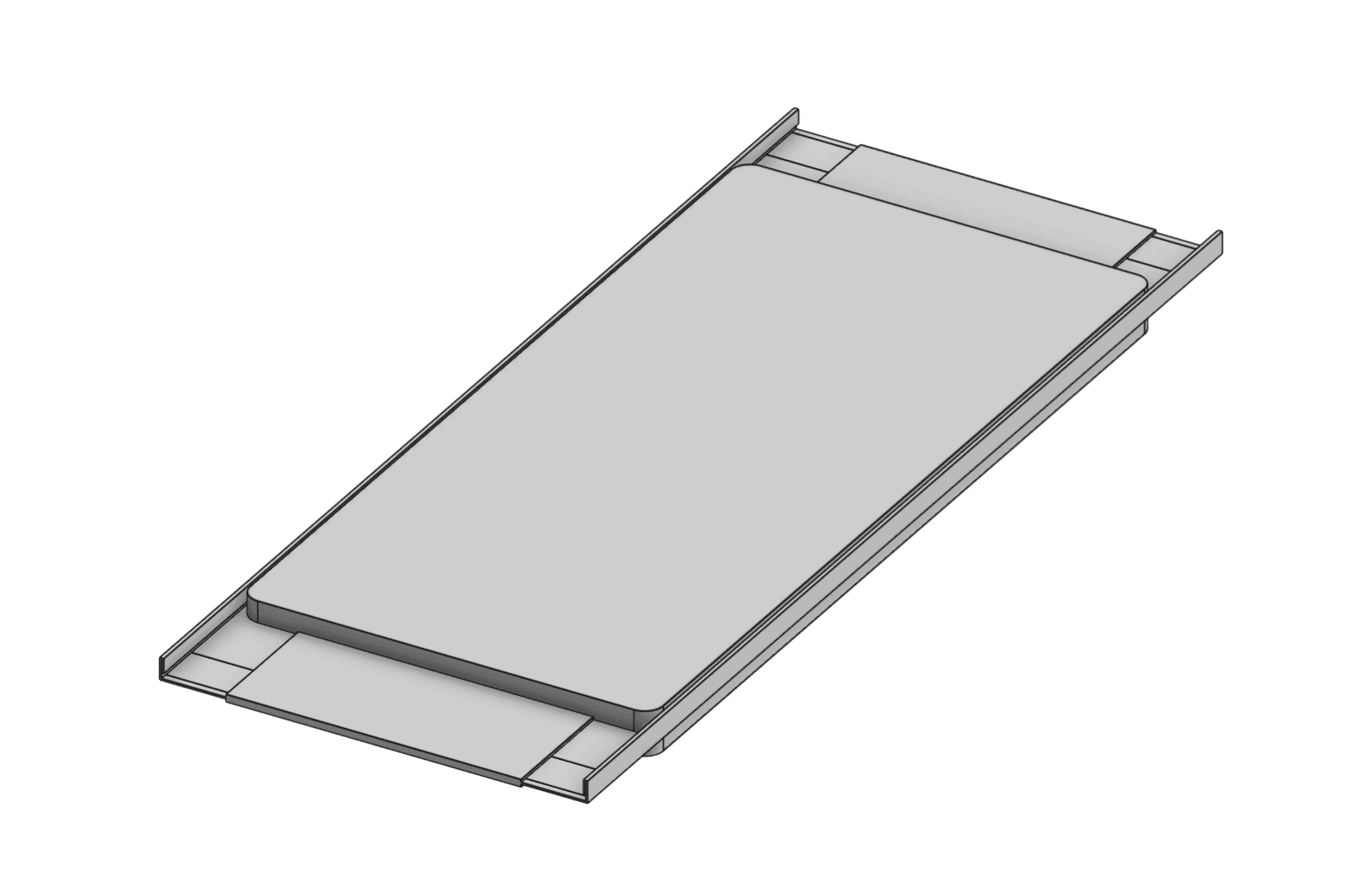
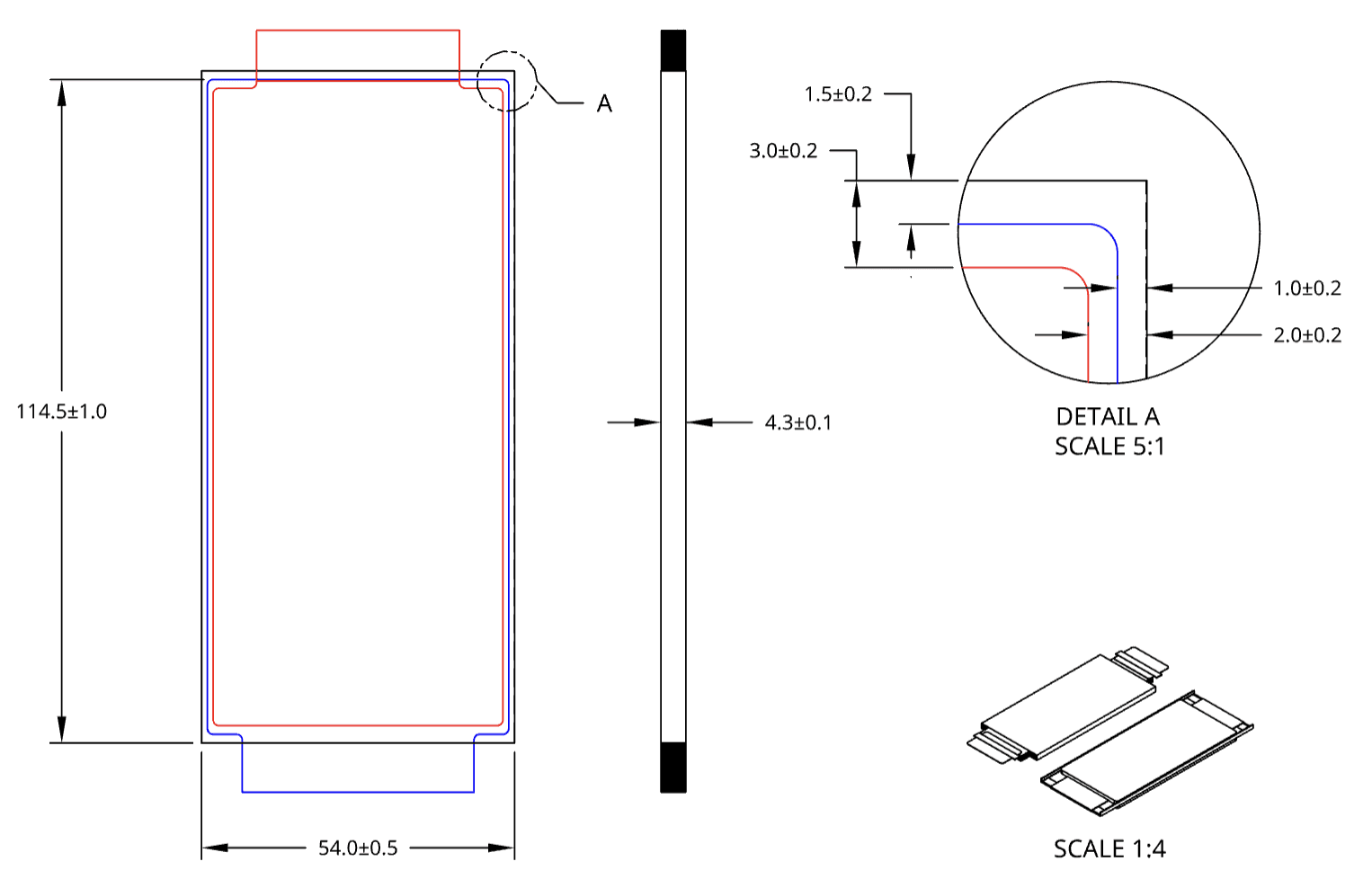
Some early CAD models of internal electrode components in battery, as well as technical drawing excerpts.
Tolerance Analysis
Next, we sought to ideate part tolerances. Tighter tolerances would ensure a safer and more efficient battery, but would dramatically increase manufacturing cost and reduce throughput.
We defined tolerance bounds with our DFMEA criteria and constructed several tolerance-stackups to identify what the tightest possible tolerance would be for every dimension of the cell.
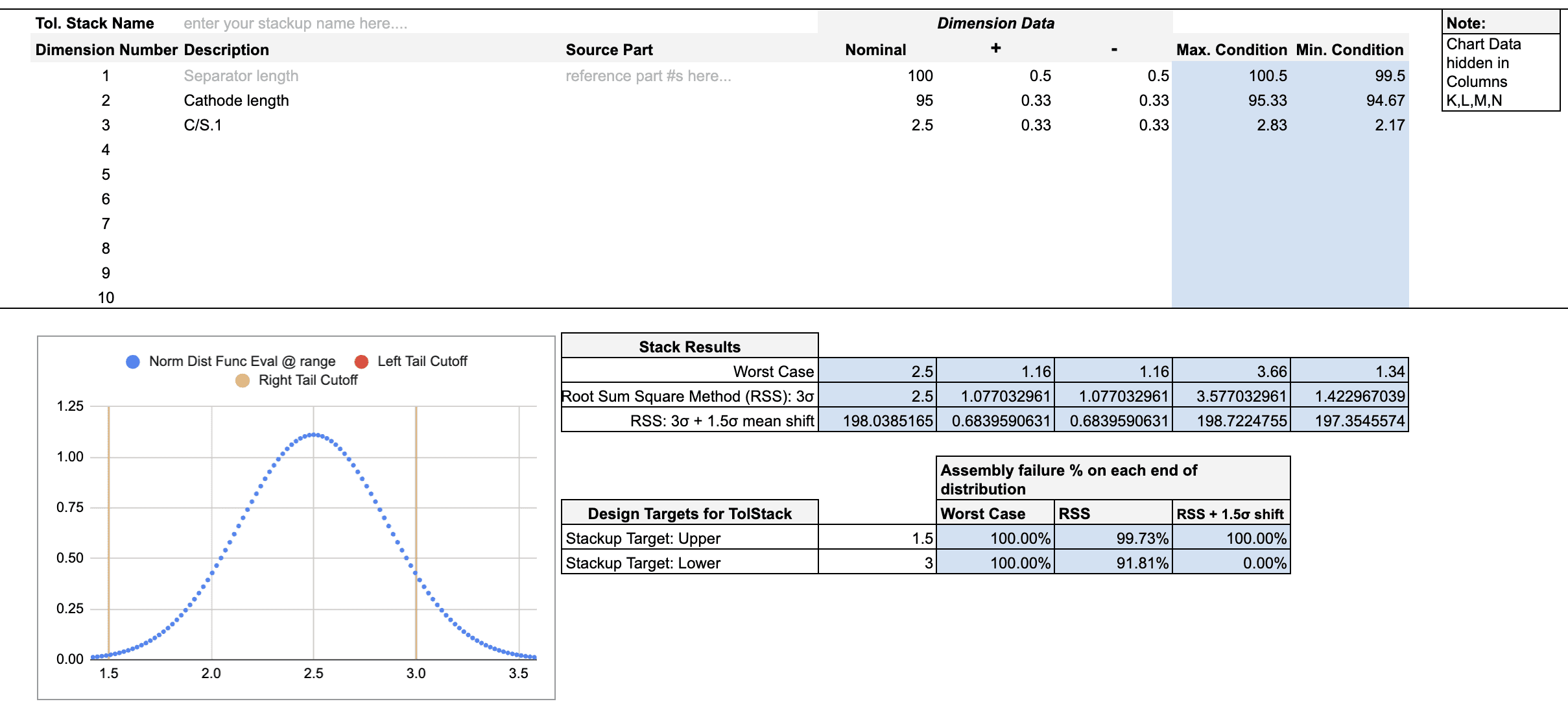
Tolerance analysis for tolerance stack-ups of different cell components.
We created tolerance stackup equations to define how individual tolerances stackup with each other. Then, we applied Monte Carlo simulations to generate the output distribution of assembly dimensions. This distribution was converted into a final tolerance that we could compare against our DFMEA.
We downselected tolerance combinations to identify the set of tolerances that satisfied our DFMEA requirements. The combination of our known nominal dimensions and the satisfactory tolerance sets constituted our first draft of our product’s mechanical design.
Prototyping
Detailed CAD
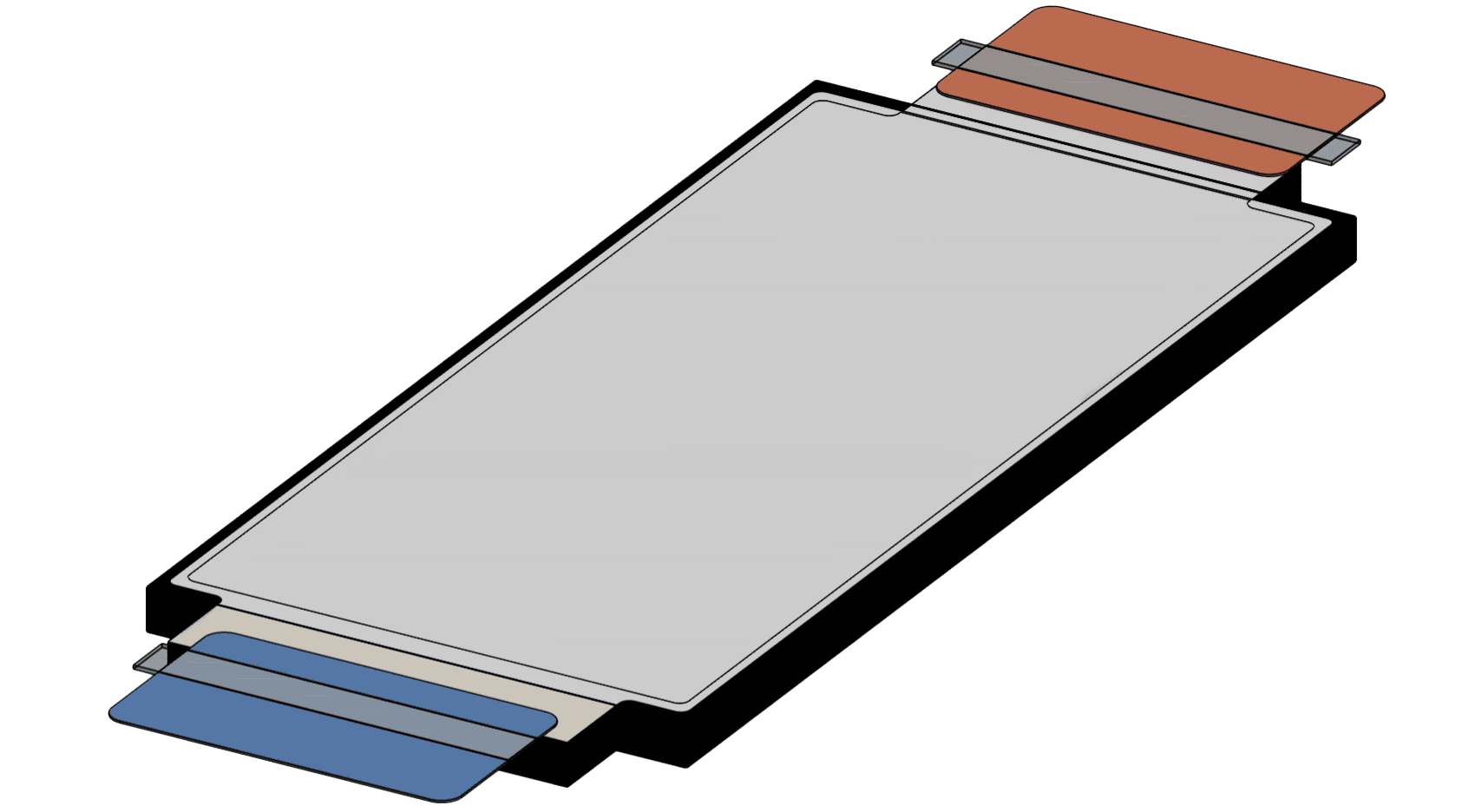
Complete cell model. Zoomed out substantially, includes all internal layers.
A complete set of dimensions and tolerances was used to generate a complete model of our battery, internal components and all. Simultaneously, we began to reserve time on in-house assembly equipment to create physical prototypes.
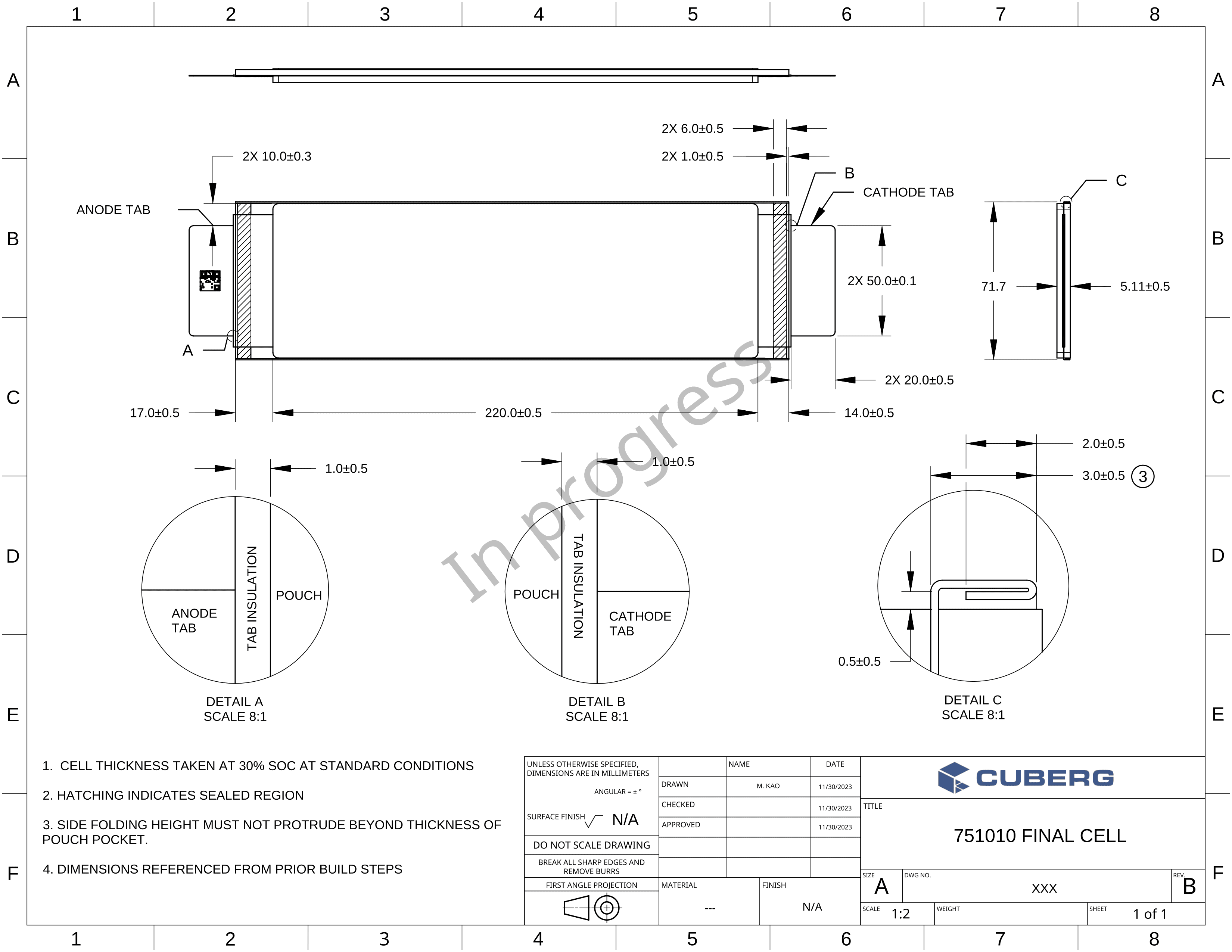
Technical drawing of full cell.
Validating Prototypes
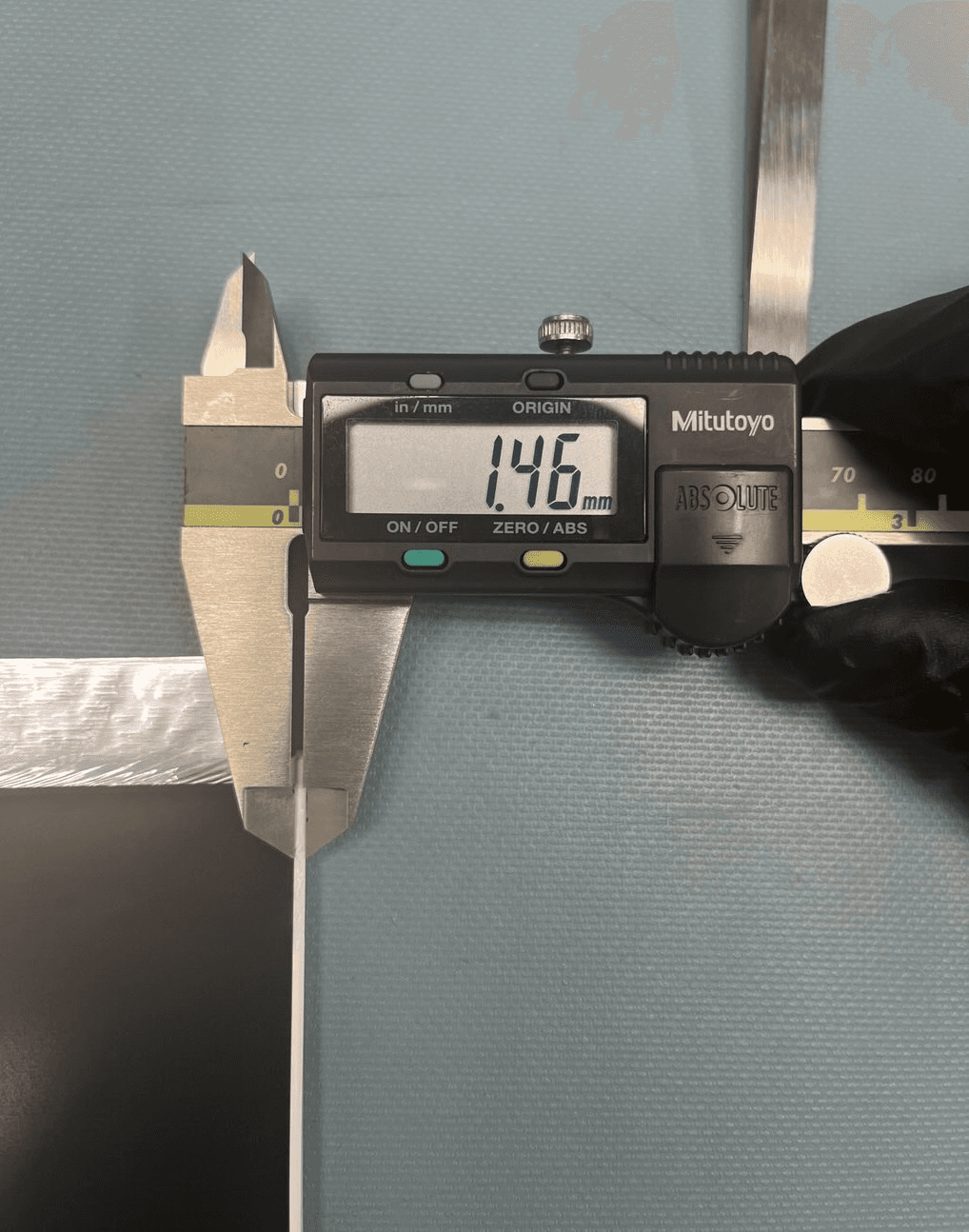
Some dry destructive physical analysis (DPA) I conducted to inspect internal component alignment during prototyping on assembly line.
Reviewing CAD and physical prototoypes with internal equipment engineers, we quickly found limits to our prototype we hadn't yet considered:
Machine capability: Our equipment suppliers had a limit to how precise they could make parts.
Process tolerances: We needed to consider not just dimensions of components but relative placements of components during assembly. This required additional geometric dimensioning and technical drawings.
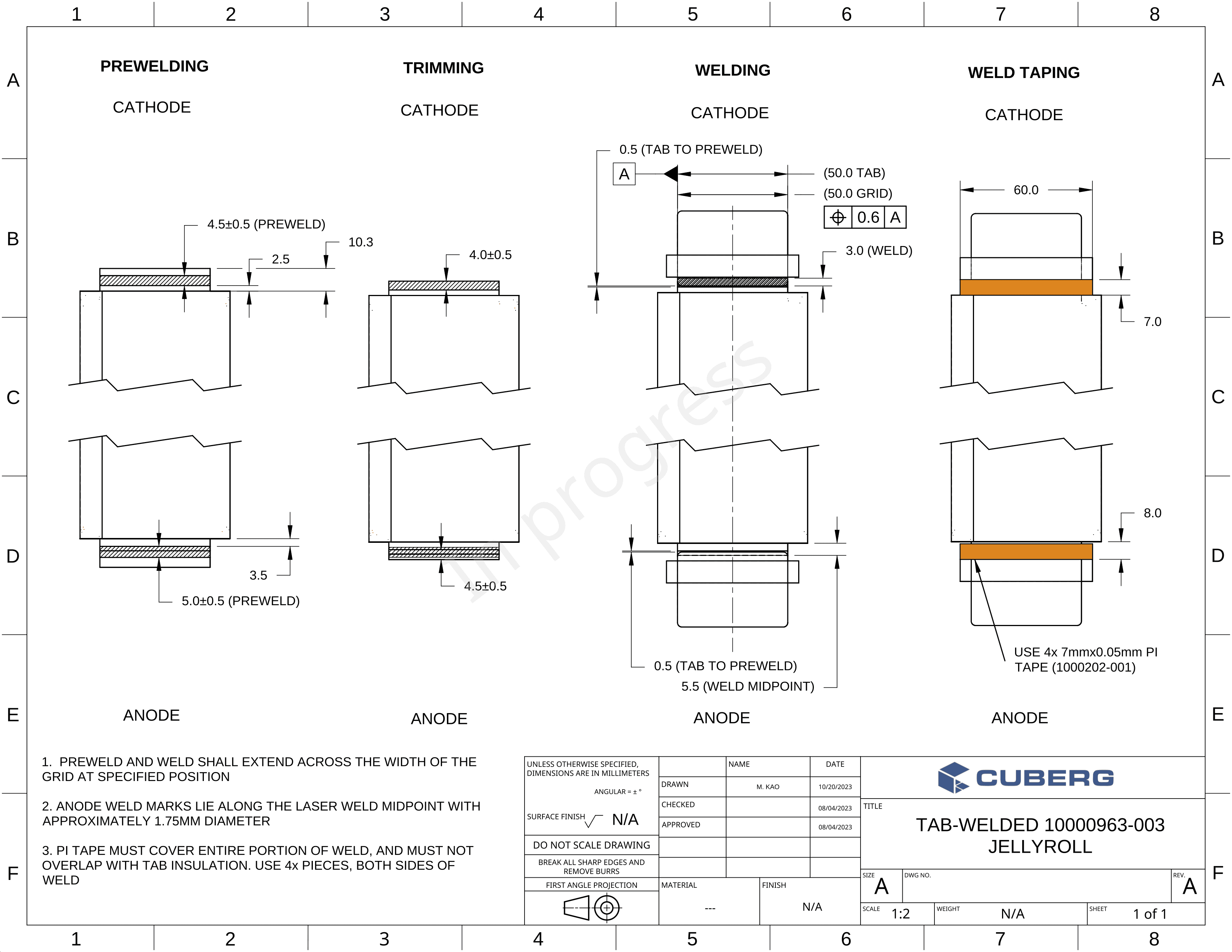
Process drawings for cell assembly, an excerpt of a specific step.
We reviewed our designs and adjusted tolerances accordingly. With physical prototypes we worked alongside manufacturing team to conducted destructive physical analysis and inspect parts were within design specification.
Implementing
Final Deliverable
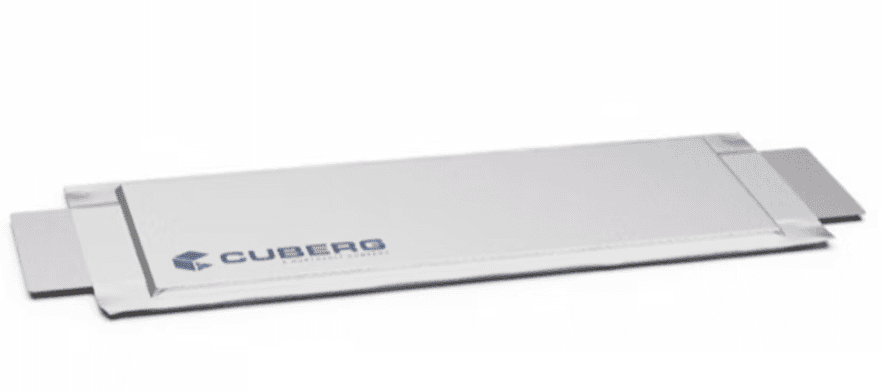
Full cell, finished.
Our work yielded a complete set of design specifications for cell dimensions, a bill of materials, and technical drawings that detailed the assembly process. This work was presented to leadership to lock in design choice and proceed with procuring manufacturing equipment.
We ultimately installed a production-ready assembly line 6 months after this project that was capable of producing cells of this design. We continued to support manufacturing teams with suppler audits, design inspection, and statistical process control to assess assembly quality.
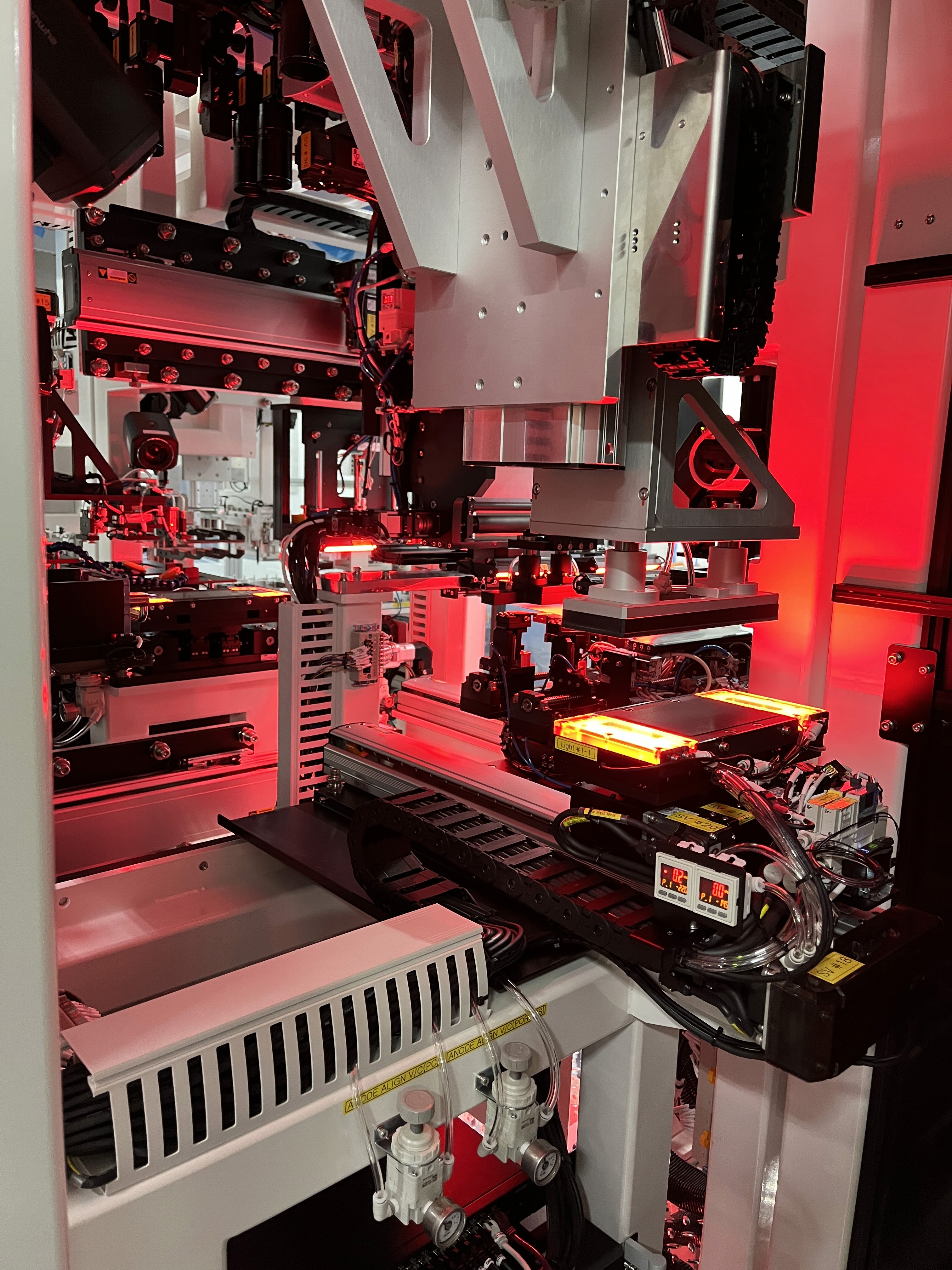
Assembly equipment picture, taken during an inspection trip with equipment suppliers before installation at manufacturing line.